
Stone Chimney Masonry Failure & Water Ingress
An insurer-led water-ingress claim was taken over from an existing building consultant and progressed through full remediation, including a scaffold birdcage access arrangement, controlled demolition of a severely deteriorated stone chimney, reconstruction in reclaimed stone and internal reinstatement.
Client Problem
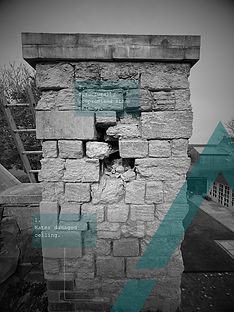
The insurer had already appointed a building consultant to investigate recurrent water ingress at a converted residential property. Their inspection identified serious deterioration to the rear stone chimney, including eroded and missing masonry and a substantial vertical crack. The project then required a contractor capable of taking the consultant's findings through to a safe, sympathetic and complete remedial outcome rather than introducing another investigative handover.
Initial Symptoms
Following periods of heavy rainfall, damp and water staining had appeared around the internally dry-lined chimney breast. Externally, the chimney showed widespread weathering, missing and degraded stonework and an approximately 10mm vertical crack. The adjoining lead valley had also previously accumulated stone debris, with temporary sealant applied at the flashing interface as an interim measure.
Investigation
Latent inherited the project following the existing building consultant's investigation. The available report, photographic evidence and recommended remedial strategy were reviewed alongside the site condition so that the identified defect could be converted into a controlled construction scope. The consultant's evidence linked the water ingress to the damaged and eroded chimney masonry and identified the cracked stack as a potential structural risk if left untreated.
Findings
The chimney was not suitable for isolated patch repair. Deterioration affected multiple elevations of the stack and the vertical crack effectively divided the masonry, while previous repairs and alterations had left a mixture of stonework conditions. Although temporary works had reduced immediate water entry, they did not address the underlying masonry failure or provide a durable long-term solution.
Root Cause
The reported ingress was attributed to extensively damaged and eroded stonework within the chimney stack, compounded by historic alteration and localised previous repairs. The degraded masonry and open cracking provided a direct route for weather penetration and had progressed to a condition where the integrity of the stack itself required intervention.
Recommended Solution
Take the defective chimney down in a controlled manner to a sound level and reconstruct it as a complete masonry element using reclaimed stone selected to remain sympathetic to the existing building. Provide full scaffold and birdcage access to create a safe working platform, reinstate the associated roof and weathering interfaces as part of the external works, and complete internal making good only after the external defect had been resolved.
Remediation
A full scaffold and birdcage working arrangement was erected to provide safe controlled access around the chimney and roof interface. The deteriorated stone chimney was carefully demolished and rebuilt using reclaimed stone, restoring the external masonry rather than relying on patch repairs to the failed stack. Following completion of the external remedial works, the associated internal water-damaged areas were remediated and finishes reinstated to complete the claim scope.
Outcome
The project was successfully taken from an existing consultant-led diagnosis through to completed external and internal remediation for the insurer. The structurally compromised chimney was removed and sympathetically reconstructed in reclaimed stone, the source area was addressed as a complete building-fabric repair and the internal consequences of the historic ingress were reinstated. The result demonstrates a single delivery route from inherited technical findings to completed insurance remedials, reducing handovers while preserving the character of the original stone building.