
Concealed DPC Interface Water Ingress
Water ingress affecting a modern timber-frame dwelling was narrowed to the concealed house-to-garage interface after drawing review, endoscopic inspection and controlled water testing provisionally discounted the roof verge as the primary source.
Client Problem
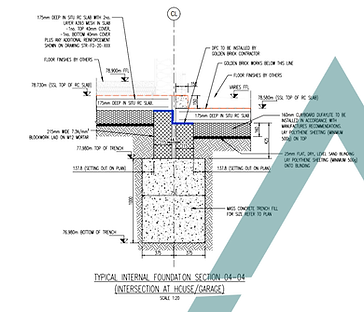
Reported ground-floor water ingress was affecting areas adjacent to the attached garage within a relatively modern timber-frame property. The visible internal damage did not establish the true route of entry and the critical construction junction was concealed within the interface between the dwelling and garage.
Initial Symptoms
Moisture-related deterioration was evident to concealed OSB sheathing within the downstairs WC, with additional staining and degradation to lower wall finishes in the hallway and technical room. Previous investigation findings had also recorded standing water, wet clay, debris and saturated materials within the concealed house-to-garage cavity.
Investigation
The investigation combined visual inspection with review of available construction drawings, which showed a damp proof course intended to bridge the cavity between the independent floor slab constructions. Endoscopic inspection was then undertaken to assess the concealed interface, followed by controlled water testing to the garage roof verge and adjoining wall junctions to test a higher-level ingress hypothesis.
Findings
The endoscopic inspection could not positively confirm the presence, continuity or condition of the specified DPC bridging detail. Controlled water testing to the garage roof verge produced no observable internal penetration or moisture tracking, allowing that junction to be provisionally discounted as the principal source. The remaining evidence focused attention on the concealed low-level waterproofing interface.
Root Cause
A final root cause could not be confirmed without direct opening-up. The evidence indicated a suspected latent defect at the house-to-garage waterproofing interface, potentially involving omission, discontinuity, damage or failure of the specified DPC detail, while higher-level water entry could not be entirely excluded until the concealed construction was directly inspected.
Recommended Solution
Undertake controlled intrusive opening-up from within the garage, removing a section of wall lining from stud to stud with temporary bracing where required. The exposed cavity should then be inspected directly to verify the presence and continuity of the DPC, identify debris or moisture accumulation, compare the as-built arrangement with the original design and establish the confirmed ingress route before remediation is specified.
Remediation
No speculative repair was recommended at this stage. The investigation established that remediation should follow direct verification of the concealed interface so that any waterproofing repair, cavity clearance and reinstatement can be limited to the confirmed defect zone rather than treating unproven roof or external-envelope locations.
Outcome
The investigation materially narrowed the defect pathway. A previously suspected roof-verge route was provisionally discounted through controlled testing, while the unresolved risk was concentrated at the concealed DPC and slab interface. This provided a clear, evidence-led basis for targeted opening-up and the next stage of defect confirmation.